

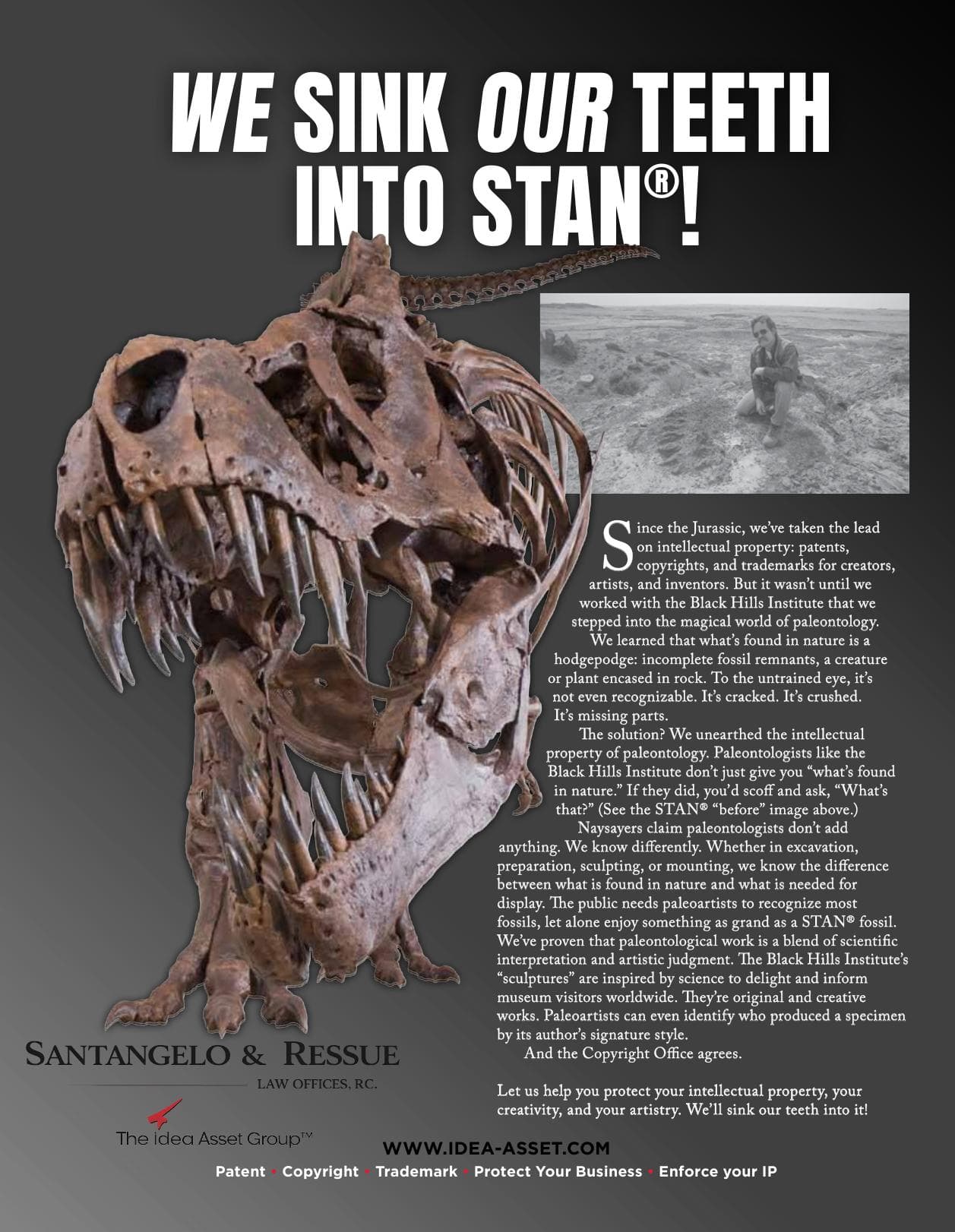
The short answer is yes, but not the fossil itself. While dinosaur bones found in nature are not protected by copyright, the original creative expression involved in restoring, reconstructing, sculpting, and mounting those fossils for display can qualify for copyright protection. That distinction led to one of the most fascinating intellectual property issues we’ve encountered while working with the Black Hills Institute and one of the world’s most famous Tyrannosaurus rex specimens: STAN®.
When people visit a museum, they often assume they’re looking at a dinosaur exactly as it was found. In reality, fossils are typically discovered as incomplete, fragmented, and often crushed remains encased in rock. Transforming those fragments into a museum-quality display requires years of scientific expertise, careful preparation, engineering, and artistic judgment.
The law distinguishes between discovering something that already exists in nature and creating original expression that adds value and allows others to understand and appreciate it. Museum-quality fossil displays often involve countless creative decisions. From reconstructing missing portions and designing support structures to determining posture, movement, and presentation. Those original contributions are themselves protectable.
This principle extends far beyond paleontology. The same concepts arise in illustrations, designs, software, artwork, and countless other creative fields. Intellectual property protects original human creativity wherever it exists.
At Santangelo & Ressue Law Offices, P.C., we enjoy helping innovators, artists, businesses, and creators identify and protect their intellectual property. Sometimes that means securing a patent or trademark. Other times, it means recognizing the value of original creative expression in places people never expect. Because innovation comes in many forms, even a dinosaur!
We were honored to be featured in the 2026–2027 Black Hills Institute Magazine. You can view our full-page advertisement, along with the rest of this outstanding publication, by clicking here.